What does the learner know now?
Meaningful evidence connects to a clearly defined proficiency scale, building an increasingly accurate picture of the student's current learning.

ASSESSMENT & EVIDENCE OF LEARNING
What does the learner know now? Pro Fish In Sea brings together proficiency scales, a body of evidence, the Marzano True Score Estimator, and teacher judgment so assessment guides what happens next.
See how it works A practical pathway with Pro Fish In SeaA score should not be a calculation of where a student has been.
It should be our best estimate of what the student knows now.
THE PURPOSE
Assessment continuously updates our best understanding of what a learner knows now. The evidence is not collected simply to produce a grade. It informs differentiation, identifies the next learning need, and helps teachers decide when a student is ready to move forward.
Meaningful evidence connects to a clearly defined proficiency scale, building an increasingly accurate picture of the student's current learning.
Use that picture to choose targeted learning, additional support, or a new challenge. Keep the expectation clear while allowing time and support to vary.
FROM EVIDENCE TO ACTION
Proficiency scales describe the learning target and increasing levels of performance, giving every score meaning.
Capture demonstrations of learning from conversations, projects, games, and the work students are already doing.
Different experiences can reveal the same competency. Quality and alignment matter more than the format.
Compare the pattern of evidence across time with three statistical models to suggest current proficiency. Teachers make the decision.
Provide targeted resources, additional instruction, supported practice, and another opportunity to demonstrate learning.
When evidence demonstrates mastery, move to the next learning need and begin the cycle again. Teachers guide the decision.
Learn → Demonstrate → Gather Evidence → Estimate Current Mastery → Respond → Learn Again
LEARNING CHANGES
Traditional grading often combines evidence collected at different points in a student’s learning and reduces it to an average. But learning is not static. Students practice, receive feedback, correct misconceptions, develop new understanding, and improve. A score should reflect that growth.
Early evidence tells us where learning began. Later evidence tells us what happened next. Sometimes the story is steady performance. Sometimes it shows consistent growth. Sometimes progress accelerates or begins to level off.
Pro Fish In Sea preserves that learning history while helping teachers distinguish between where the learner has been and where the learner is now.
ESTIMATE CURRENT MASTERY
The Marzano True Score Estimator analyzes a student’s evidence across time to help determine the score that best represents current proficiency. It does not simply average every score or automatically choose the latest one.
Looks for evidence best represented by a relatively stable level of performance.
Looks for a consistent pattern of change across the evidence over time.
Looks for a changing trajectory, such as learning that accelerates or begins to level off.
Each model is compared against the student’s actual evidence. The model with the least prediction error becomes the best-fit model and produces a suggested current score.
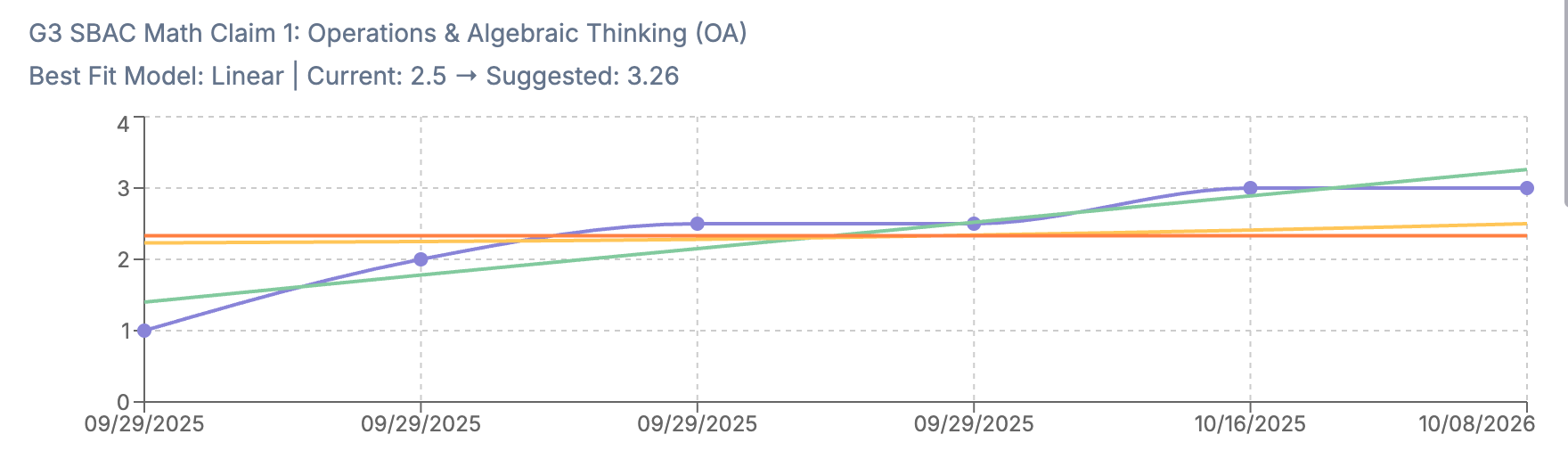
READING THIS EXAMPLE
The accumulated evidence shows an upward trajectory. Because the linear model best explains that pattern, the estimator suggests current proficiency closer to 3.26. This is a model-based estimate, not the latest observed score and not a guarantee of mastery.
THE TEACHER’S DECISION
The teacher still makes the professional decision. The technology asks: given everything this student has demonstrated, what score best represents what they know now?
MORE THAN A NUMBER
A suggested score is more useful when teachers can understand why it was suggested. Pro Fish In Sea makes individual demonstrations, performance over time, the growth trajectory, the best-fit statistical model, the current recorded score, and the suggested True Score visible.
This keeps professional judgment with the educator while giving teachers a stronger evidence base. If evidence shows a learning need, respond with targeted instruction, additional practice, different resources, or another opportunity to demonstrate learning. If it demonstrates mastery, move forward to new learning.
THE PRO FISH IN SEA PATHWAY
Learning experiences and evidence of proficiency are not the same thing. When an experience produces valid evidence of a target, teachers can capture it and use it to guide the next step.
Some of the best evidence never shows up on a test: the explanation to a partner, the question asked at a station, the “aha” during a small group. Pro Fish In Sea’s Non-Obtrusive Assessment tools let teachers record that evidence in seconds, right from the lesson plan, for each student in the group.
The same quiet scoring is available while reviewing AI tutor conversations, so teachers can capture reasoning that demonstrates the learning target without adding a separate test.
Maya R.
3.0Jonah P.
2.5Ava L.
3.0Luis M.
PendingA test is not the only place learning becomes visible. Students may demonstrate proficiency in a discussion, project, performance, game, student-created activity, tutor conversation, teacher observation, or traditional assessment. Pro Fish In Sea connects relevant demonstrations to the same learning target and proficiency scale.
The format may change. The expectation does not. What matters is whether the evidence validly demonstrates the target, not whether it came from a test or how polished the presentation looks.
Observed in lesson
Explained ratio tables to partner · Today
AI tutor conversation
Set up ratio without hints · Yesterday
Practice game
Explained a ratio comparison during play · Mon
Student video artifact
Recorded reasoning for a goal · Last week
Proficiency scales describe exactly what 2.0, 3.0, and 4.0 look like for each target. Teachers score work against those descriptions, and students see what they need to show next.
Shared descriptors help teachers make consistent judgments across classrooms. A score communicates demonstrated learning against the target, not points collected along the way.
Applies ratios to a new, real-world problem and explains the choice.
Uses ratio tables and language to compare two quantities.
Recognizes ratio vocabulary and completes simple tables with support.
Reassessment is more than taking the same test again. Teachers use the evidence to identify the learning need, then provide targeted resources, additional instruction, coached practice, or a different approach before another opportunity to demonstrate mastery.
Students can revisit the target at their station, work with the tutor, and submit new evidence. Teachers review what has changed, update the picture of proficiency, and decide whether more support or the next challenge is appropriate.
Exit ticket reveals a gap in ratio comparisons
2.0Targeted station practice + teacher and tutor support
2.5New evidence: video explaining a ratio comparison
3.0Teacher reviews readiness for the next challenge
NextTeachers and students see progress toward proficiency over time, not a single snapshot.
Reports show where students stand on each target at any date, clear for families and leaders.
A gap points to targeted instruction and supported practice. Demonstrated mastery points to the next learning need.
SHARED RESPONSIBILITY
Understand where they are, what to work on next, and how new evidence can show growth.
A richer body of evidence for targeted instruction, timely feedback, and decisions about readiness.
Shared proficiency expectations and clearer conversations about learning across classrooms.
Reports that describe what their child can do, not just a percentage.
The platform supports the work; educators make the decisions. Interface previews show illustrative content, not measured impact or guaranteed outcomes.
THE PROMISE OF COMPETENCY-BASED ASSESSMENT
Pro Fish In Sea brings together proficiency scales, multiple sources of evidence, learning history, statistical analysis, and teacher professional judgment to create a clearer picture of current mastery. The result is not simply another grade. It is information teachers can act on.
Every piece of evidence adds to the story.
The pattern tells us where the learner is now.
Where the learner is now tells us what should happen next.